Monday, February 2, 2026
How AI Summaries Are Quietly Killing the News
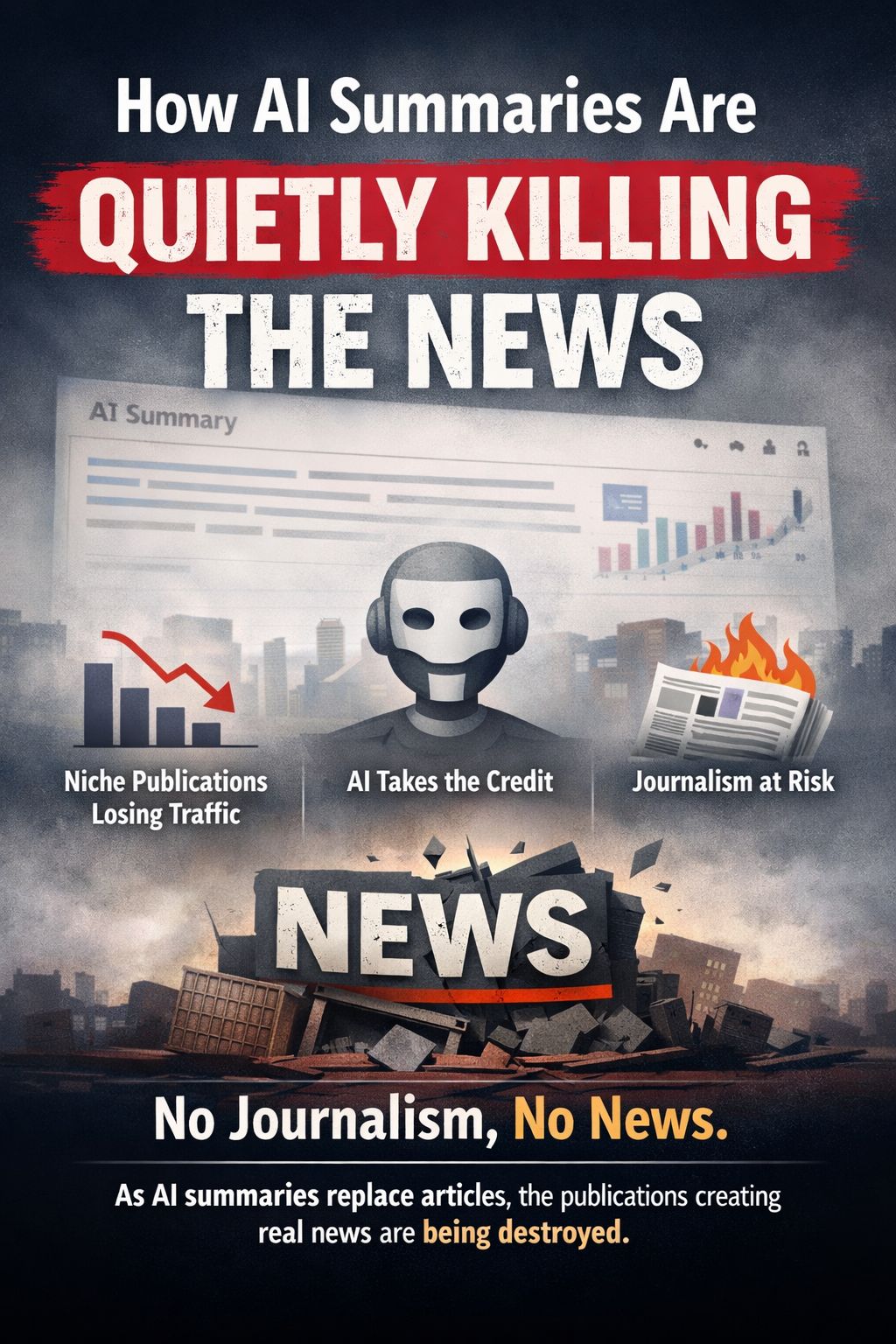
How AI Summaries Are Quietly Killing the News
For years, news publications were told that if they did their SEO right, their articles would find readers. Search engines rewarded original reporting with visibility, and organic traffic was the lifeline that kept especially small and niche publications alive.
That world is disappearing.
Today, when you search for a news event or a topic on Google or Bing, you are no longer led first to the reporting itself. Instead, the search engine scans multiple articles and presents an AI-generated summary at the top of the page. Below that come paid results. Only after that, if at all, do you see links to the original articles.
Many readers stop at the summary. It feels complete. It feels convenient. And so they move on.
The immediate consequence is obvious: drastically reduced traffic to news websites. But the deeper consequence is far more serious, especially for niche and specialised publications.
These publications do not survive on brand recognition or massive advertising budgets. They survive because they report on issues that larger media houses ignore, and because search engines once helped connect that reporting to the readers who were looking for it. When AI summaries replace clicks, that connection breaks.
What makes this even more troubling is what comes next. Search engines are rolling out features that allow users to ask follow-up questions directly to the AI. The answers may still rely on reporting done by journalists and publications, but the user never sees the source. They see the search engine. The publication becomes invisible.
The content is still needed. The reporting is still valuable. But the organisation and the people who created it are cut out of the loop.
Over time, this creates a fatal feedback cycle. As traffic falls, revenues decline. As revenues decline, newsrooms shrink or shut down. As fewer publications are able to afford original reporting, there is less high-quality content for AI systems to summarise in the first place.
The end result is not better information. It is less journalism, fewer independent voices, and eventually a thinner, poorer news ecosystem. Niche publications, which often do the most rigorous and ground-level reporting, will be the first casualties.
AI summaries may feel like progress, but without a sustainable way for news organisations to survive, they risk hollowing out the very foundation they depend on.
If we care about the future of journalism, we need to rethink how readers discover and support news. Building direct relationships with audiences, rather than relying entirely on search engines, is no longer optional. It is a matter of survival.
Platforms that prioritise publishers and readers over algorithms can be one part of that solution.
The alternative is a future where the news slowly disappears, not because it is no longer needed, but because those who produce it can no longer afford to exist.